Tuesday, September 25, 2007

Al Rasheed Street

Al Rasheed Street used and still one of the main centers in Baghdad, where retail storage spaces, cafés and restraunts, small and big shops, private and government services buildings, clinics, pharmacies, photography studios, laboratories, record shops, sawing factories, and many more of every profession one can imagine, all interlaced within each other. The same goes for the masses of people of different ages and gender walking on each side of the street, and the hundreds of cars drove by side by side dead slow - from ancient cars (like the Russian Volga) to the most luxurious Alpha Romeo. Any visitor can acknowledge that Al Rasheed Street is just one perfect example of random society classes in one place; where the extremely poor can be seen as well as the lavish rich. There was also time when movie theaters used to show the latest Arab and Western movies, where families became regular visitors to these theaters, but this has been gradually diminished over the years to the level of showing what it used to be called "film every 15 minutes" for teens from surrounding public areas and soldiers from military units located around the capital, who used to seek a cool place so they can have some sleep during the bloody hot summer days. Thus, no interest if the star in the film gets killed or he discovers that the old women found in the abandoned village is in fact his forgotten aunt from childhood!!

The origin of Al Rasheed Street goes back to the Ottoman era who ruled Iraq from 1534 to 1918. During that time, the only known public street in Baghdad was Al Naher Street (Shari al-Naher), which was constructed in 1910, during the rule of Nazim Pasha (1848 - 1912), who governed Baghdad twice: the first in 1908, and the second for 11 months between 1910 and 1911. Al Naher means River - the street is stretching few kilometers along the east banks of the river Tigris and this might be the reason behind its name. However, people used to call the narrow Shari al-Naher with other names, such as Gold Street, because of the countless number of goldsmith and jewelry shops spread on both sides, and Girls’ Street, because the majority of the street’s visitors were females from different ages.

After the defeat of the British by the Ottomans on the 29th of April 1916 in Kut (south of Baghdad), where tens of thousands of Anglo-Indian troops dead or wounded, and thousands more taken prisoners, including their commander, Sir Charles Townshend (It is regarded by many historians as the biggest humiliation in British military history), the military governor of Baghdad, Khalil Pasha (1864 – 1923), decided to honor this victory by giving orders to build the first ever "real" street in Baghdad. Work began in May 1916, after the head of Baghdad’s municipality, Ra’ouf Al Chadirchy met with owners of houses to pay them compensations for the demolition of their houses which will be demolished. The way that street was constructed in the planning phases was very primitive and strange: a long rope was put through on top of the houses from the beginning to the end. Some people sighted the laying robe over the roof of their house as a catastrophe; hence, the rope has been thrown many times from the roof of one house to the other. There were more problems, though: there was the burial place of a religious Imam Taha (where the statue of poet Ma'rouf Al Risafi now stands) and the wall of Haider Khana Mosques. Both were dealt with: The wall was demolished in the middle of the night, and the remains of the Imam Taha also has been extravagated and moved to Salman Pak (west of Baghdad) in the middle of the night.
The street was first opened for the public on July 23, 1916 (the anniversary of declaration of the country’s constitution). The first name given to the street was by Khalil Pasha who named the street “Jadde Si”. The name of the street was written then on a ceramic plate and put on the main wall of Sultan Ali Mosque till mid fifties of the last century. For almost a year, the street was badly maintained, filled with dust, mud, and holes untill the British seized Baghdad on 11 March 1917, when a decision was made to reconstruct the street. The British paved the street and gave it a new name: "New Street" (Al Sahri Al Jadeed). However, the Baghdadis preferred to call it "the Main Street" (Al Jadde Al Umomiyeh).

During the 1920s, people began to identify regular passers and visitors, such as cars where prostitutes sitting in the backseat their covered head - The government during that time made an order that every prostitute must cover their head and body with the common black robe (Abaya, in Arabic) and wear dark blue soaks to diffrintiate them from other women. In the 1930s Baghdadis got used to see every afternoon twice a day two big black Buick seven seats drive by: one of them belonged to the famous estates owner Bahiya Al Urbiya. She used to sit in the backseat and was known for her beautiful smile she greets the pedestrians with when she passes by. The other black Buick belongs to Regina Murad, also a well known estate owner and a woman of power due to her connections with officials such as ministers and political party members. From the 1930s onwards, other streets in the meantime were constructed and re-organization of the great city of Baghdad took place. In addition, many new faces of people from country side moved to the city during the forties and fifties where they brought their own cultures and traditions. All in all gave the street different and unique flavor! On this same street young men and woman from different political parties in the fifties came out carrying their slogans against what they believe wrong. The street also was the theater of political assassination attempts, such as that of the first president of Iraq, Qasim, and confrontation with the British occupation.
There are a lot to talk about Al Rasheed Street, which will remain an eternal spot in the history of Baghdad forever despite attempts to silence its unique music made by its inhabitants.


Monday, June 25, 2007

The Queen of Contemporary Arab Poetry

She was a writer, an innovator, an activist, an artist, a musician, and the least to say about her that she was someone who could speak English, French, German and Latin fluently.

The 20th of June, 2007, marked another sad day in the modern history of Iraq when Nazik Al-Mala'ikah has died at the age of 84 years old in Cairo, Egypt. Mrs Al-Mala'ikah is known as the one who revolutionized Arab poetry in the late 1940s by introducing free verse (or taf'ila) or what formally known as the prose poet. She was born in Baghdad in 1922 from an educated family whom both parents used to write poets and they were distinguished writers at that time. This gave little Nazik the motivation to start writing on a very early age, and when she was in college, her poems and writings were already published in newspapers and magazines.

Nazik Al-Mala’ikah obtained the BA degree in Literature from University of Baghdad in 1944 and the MA degree in Literature in 1954 from the University of Wisconsin. In addition, she has been granted scholarship in 1959 to study at Princeton University, New Jersey, the United States where she studied Latin, French and English. During her years before traveling to the U.S, Mrs Al-Mala’ikah joined the Institute of Fine Arts in Baghdad where she learned to play the Oud (Arabic Lute) and took lessons in acting too.

Both her early works, the 1947 ‘A'shiqat Al-Layl’ (Lovers of the Nights) and the 1949: ‘Shazaya wa ramad’ (Shrapnel and Ashes) were considered the pillars for changing the 500 years classic form and structure of standard Arabic poetry, but the one and only work which marked the beginning of using the free verse poetry (or the prose poet) was in ‘Cholera’, which based on the tragedy that plagued Egypt (and Iraq afterwards) in the late forties of the twenty’s century. However, there is who dispute this claim and give the credit to another legend in contemporary Arab literature, the Iraqi writer Badr Shakir Al Sayyab.

In the years to follow, especially in the 1960s, Mrs Nazik Al-Mala’ka kept on calling for the modernization of the forms Arab poetry is written and to find new ground for more sophisticated methods. This was clearly illustrated in her work Qadaya 'l-shi'r al-mu'asir (Issues On Contemporary Poetry) in 1962.

In addition to being a poet and a writer, Mrs. Al-Mala’ika was regarded as a strong defender of Women rights and her various articles and lectures in the 1950s are a better witness of her strong stand regarding this issue.

Al-Mala'ika did not limit herself within the boundaries of Arab litreture and poetry, she also expanded her knowledge and her translations of western/ foreign writers such as Byron, Thomas Gray, and Rupert Brooke is another great achievement. I wonder if there is any achievement by writers and literates to translate this legend’s works into other languages!

In 1957, she became a lecturer at the University of Education until the late 1950s she left to live in Beirut, Lebanon, where most of her works have been published. She is also gave lectures at the University of Basra, a place which she with the help of her husband and former university colleague, Abdel-Hadi Mahbouba, both found in the mid 1960s. In addition, Mrs Nazik Al-Malayka taught at the University of Kuwait for many years until 1990 when she was forced to return to Iraq after the invasion of Saddam to that Gulf state, and after the end of the 1991 war, she moved with her family to Cairo where she went through a semi self-isolation till the last day. Despite that, Mrs Al-Mala’ika published in 1999 her last book, called Youghiyar Alouanah Al-Bahr, which in fact a collection of her writings dated back to 1974. Further more, the Egyptian Supreme Council for Culture has published big collection of Al-Mala'ika's work (if not all) in two big volumes. The first includes Qadaya Al-Shi'r Al-Mu'asir (Issues of Contemporary Poetry, 1962) and Sykolojia Al-Shi'r (The Psychology of Poetry, 1979), while the second includes Al-Sawma'a wal-Shurfa Al- Hamraa (The Hideaway and the Red Balcony, 1965), Al-Tajazu'iya fil- Mujtama' Al-Arabi (Disintegration in Arab Society, 1974) and Al-Shams Allati wara' Al-Qimma (The Sun behind the Summit), a collection of short stories written through the 1950s, 1960s and 1970s. Here is a page where it claims to contains all the work and writings of Nazik Al-Mala’ika (in Arabic)

My condolences to Mrs. Al-Mala’ika’s family and May God rest her soul in peace. The 20th of June 2007 is another sad day in the life of Iraqis because another candle that lit the literature domain in the history of modern Iraq is put down!

Al-Mala’ika’s is a pride for all the Iraqis due to her achievements. She became the symbol for many Iraqi women around the years to follow in her steps: full of motivation, carry many dreams, and high hopes for a better future for themselves as individuals as for their country they love. This is another Iraqi woman I am proud of.

Thursday, April 12, 2007

Al Sarrafiya Bridge

Many Iraqis used to call it the Iron Bridge, but the official name was Al Sarrafiyah bridge. It links al Wazeeriya district east of Baghdad (Risafa) with Al Latifiya district on the west of Baghdad (Karkh).

Al Sarrafiya Bridge was built in 1951by the British when they were occupying Iraq at that time. Some sources indicated that the bridge was meant to be built in Sydney, Australia, but at later date the British decided to build and put the bridge in Baghdad. Some sources indicate that the main purpose for building that bridge was military.

There is who believed that the interlaced steel at the top of the bridge were made to make the shape of the British flag and can be clearly seen from an airplane above! There also some myths about that bridge; that the Imam Al Mahdy had appeared for some people at that bridge. According to historians, Al Sarrafiya Bridge was built on the same location a house for mentally ill people used to be kept in the late 18’th century, and maybe before that date.

The bridge is 450 meter long above the Tigris River and 6 meters wide. There is two meter wide for pedestrians. There is also a railway track on one side of the bridge, and until the 1970 of last century, the train used to pass through crossing between the east and west side of Baghdad. In later years, when railway tracks were suspended, the Iraqi government extended the pedestrian space to include some of that area set for the train tracks.

Tuesday, March 27, 2007

This IS Iraq

It might be on other blogs, I don't know, it might be seen by many, I don't know, but thanks to Laith who brought my attention to this video a while ago.

This is Iraq, this is what Iraq The Lasting Love blog is all about. This is how Iraqis used to live! I am going to borrow a comment on this wonderful video to simply describe it:

"This video is about Iraq, its not about politics, its about how people remember their homeland, Iraq is not Saddam, This country is the where all the human civilizations started."


Thanks Laith, one more time, for the great work, thanks for showing a glimpse of how Iraq used to be.

Sunday, March 25, 2007

You Shouldn't Be Proud

“You shouldn’t be proud of your origins” she added: “you are a citizen of another country now, and this is the only nationality you should be proud of!” My friend was almost paralyzed, but replied “How can I ignore 8000 years of history?” She replied back and said “You didn’t make that history. You are not part of it! Therefore you shouldn’t be proud of it”

This was a conversation between a friend at work and her new colleague who settle recently in the Netherlands. The remarks were made by the new colleague after she discovered the Iraqi origins of my friend.

One can wonder if this a sort of stupidity to throw such remarks, or is it a matter of whether someone should either have loyalty to that country or to the other he or she originally came from! Or maybe the loyalty issue is not relevant in the first place in relation to such a debate?

Can my friend ignore the fact that her country is the cradle of all civilizations?

Iraq is the country where wheels and writing were invented. It is where stars were measured for the first time by scientists and it is in Iraq that the first irrigation systems were built on the banks of the river. In Iraq the first constitution in the history of mankind has been written. In addition, according to historians, Iraq is where the first epic movie ever made during the Assyrian Emprie era in its own form: by telling stories through drawing figures on huge vertical cuneiforms telling about events involved heroes, enemies, prisoners of wars, battles, lion hunting and conquerors. All were tales of a mighty empire that stretched from Egypt to Persia in very enjoyable details.

The achievements of Ashurbanipal alone are just one living example of the kind of great leader he used to be. For example, historians and scholars until this day are studying the contents of the Ashurbanipal’s grand library which he built in Nineveh and contained 20 to 30 thousand cuneiforms, put in separate chambers according to subject categories, and varied from languages of different cultures to government matters, politics and military, to science and society.

It was Ashurbanipal’s grand library that introduced us to the first tale ever told in the history of mankind: The "Epic of Gilgamesh".

Scholars and historians gave Baghdad different names: some called it the house of peace, others called it the golden city, and other preferred to call it with the original translation of the word Baghdad, which is derived from ancient Persian language: the gift of god ("bagh" meaning God, and "dad" meaning gift). It is the city where works from other languages such as Greek, Persian and Indian have been translated and made Baghdad during the golden middle ages as the bridge where east meet west through many aspects of life, whether cultural, commerce, education or politics.

Baghdad was considered the largest city in the entire world from the date of its foundation in 762 to 930 A.D.

From Baghdad, Long before the time of female politicians star rising in othe Arab countries, such as Sheika Lubna al Qassimi of the UAE, and Masouma Mubarak of Kuwait, Nezihe al Dileemy was born in 1922, who became the first female in the modern history of the Arab world to be take a position of a minister. Dr al Dileemy achievements where not limited to politics, but also included social and humanitarian activities from the early days she was a student at the medical college, and remained for years to come. Such achievements included the struggle to promote world peace, the protection of children, and participating in research projects and campaigns in the fight against plagues and diseases, such as the research on Primitive syphilis disease, which took her from the north of the country to the southern marshes of Iraq, and from the desert of western Iraq and in around the different area in Baghdad. She was the first to call for establishing a union for Iraqi woman and in early 1950s was the first chairman of what became later the Iraqi Woman Association. With her efforts and determination she succeeded in making the Iraqi Women Association part of the World Democratic Women Union in 1952, where she became a couple of years later its vice-chairman. Final achievement of Dr al Dileemy before retirement was in 1999 when she organized a big seminar on the situation of Iraqi Women and the challenges she faces in society.

This is Iraq, this is the country that the new colleague demanded from my friend to distance herself from and never be part of its history and its people. I don’t know if my friend will be able to choose the part of history in Iraq she should put behind her. In other words, should my friend disown the history of ancient Mesopotamia? Or should it be Baghdad and the Golden Era of Iraq’s middle Ages? Or to ignore distinguished figures helped in shaping its modern history???

Friday, February 16, 2007

Iraqi Customs

Every country has its own traditions, clutural background and own historical influence, which have impact on their behavior, dialogue, interaction with other cultures, and even the food they make. Customs is als regraded as another heritage any society or a community within the one society that influence and can be influence. Take, for example, Bavarians in Germany, they are people who are very proud of anything relates to their community; they are a proud of their accent, proud of their German Beer steins, and their special beer, of course. On their festivals, they are proud to wear their traditional customs, where men's pants are specially made of red deer leather, and woman wearing their zipper front dirndles with a colorful apronin, while all together playing and 'Yodelling' their own folk music - whom they kept on listening to them generation after generation...etc Simplicity in clothing also became distinguishable in some cultures. We find the Mexicans, for example, who are famous with their wide hats, sandals (whom they call it huaraches), and the sort of a blanket covering their shoulders with gap in the middle for the head to protect them from the cold during winter season.

However, Iraq, with its all diversities in religion, geographic nature and various societies, all that have been reflected in customs and clothing. Many factors played a role in the way Iraqis from the north or the south choose and select their clothing. Influence from other countries such as Iran, Turkey, the Hijaz (now Saudi Arabia) made its touch on the way Iraqis wear their clothes. We find the Abaye, a women dress influenced mainly by Iran. However, there are other communities in Iraq who inherited their customs from their fathers and grandfathers, this can be very clear illustrated when going to the north of Iraq and see customs of the Kurds.

Below is a number of sketches showing some of Iraqi customs from the different areas in Iraq. The custom were printed out on different Iraqi postal stamps. I am not sure which year these stamps were issued, but from the amount written on each stamp, I conclude that it is either late 1970s or early 1980s.

I want to point out here that these sketches are not entirely accurate, they have already gives the closest idea on how Iraqi custom from north to south used and still is.


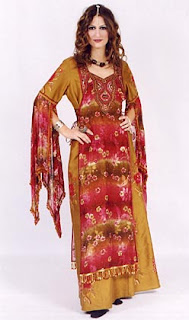
Fashions and fashion shows were not something foreign on Iraqi society. The first fashion centre in Iraq was in 1969, by artist Firyal Al Kelidaar, who came up with the idea at that time during her trip back from a fashion exhibition in Rome, Italy, when she noticed that one of the customs designed during the show was inspired by the Akkadian culture without any mention to that. Thus, the main purpose for establishing the fashion design center in Iraq was not for commercial reason, its purpose and pure goal was to re-live the achievements in that regards of ancient civilizations in Iraq, from Sumer, Akkad, through the Islamic heritage, into the Iraqi folklore. The first Iraqi fashion show was in 1970, in Rome, Italy. This followed by a tour in other European countries, East Asia and North Africa. In 2003 the Iraqi Fashion Centre continued its work gradually after months of hault due to war and looting and there are plans to present Iraq and its great civilization through fashion soon.

Below are a number of pictures of Iraqi models wearing different clothing made by Iraqi fashion makers


Tuesday, February 13, 2007

Kahramana & the 1000 Nights

Kahramana roundabout is regarded as one of the most famous spots in Baghdad. It is located on the crossroads between the famous Karrada Dakhil and Karrada Kharij districts. People driving by the roundabout can see the Statue of a beautiful young girl carrying a jar and pouring water down and surrounded by another forty jars around her. The statue was made during the 1960s of last century, by the artist Mohammed Gheni.
Many Iraqis believe that the statue of Kahramana is somewhat related to the story of Ali Baba and the 40 Thieves, from the 1000 Night and One Night. However, there are who tell another story about the young and smart Kahramana, who used to help her father running a small hotel in old Baghdad. The father used to bring a cart full of empty jars, and in the next morning he fills each jar with oil and sells them in the market. On a cold winter night, Kahramana heard some noise and later discovered that there were thieves hiding in the empty jars. Their heads were only visible to watch. Kahraman went to her father’s room, woke him up, and told him about what she saw. They came up with an idea to make some noise in the hotel so the thieves would hide completely inside the jars. When this happened, Kahramana filled a jar with oil and started pouring the oil on every single jar with a thief hiding in it. The thieves began screaming, and one after the other jumped out of the jars, by the time this happened, the police came and arrested them.

The statue of Kahramana still intact till today. There were some maintenance applied, such as painting, and planting some flowers, but familiar pouring water from Kahramana’s jar dried for some time now.

For artist Mohammed Ghani, Kahramana’s story was not the only inspiration from him taken from the tales of Thousand Nights and One Night. He made later another beautiful statue, which became a landmark among sites in Baghdad; driving through the Abu Nawas Street, there is on the right side two big statues of king Shahrayar and his wife, Shahrazad. It is featuring a man of royal status sitting and watching a standing beautiful woman who are spreading her both hands to either side like wings. Both are the main characters in that famous tale. The story of Shahrayar and Shahrazad is about the king whose queen betrayed him and he had her killed. He decided then to marry a woman every night and kill her in the morning, so she won’t betray him. Shahrazad was the daughter of the Vizier who taught her the art of storytelling since she was a small girl. When she knew about the king, she decided to stop all these executions ordered by him and submit herself as the next bride.
She was certain of making the king changes his mind about women. On the first night of marriage, she asked the king to spear her life, and in return she will tell him a story before going to bed. The king agreed and spent the whole night listening to Shahrazad’s story till dawn time. The king fell asleep before Sharazad finishes her story, so the next day he decided to spear her life and listen to the rest of the story. The same thing happened on the second night and the third and the fourth, till it reached thousand nights and one night.