Showing posts with label History. Show all posts

Sunday, September 27, 2009

More from Iraq’s Old Days

I don’t want to give the impression that I am pro-monarch person regarding the political system in Iraq because of the many occasions where I put pictures of that period on my blog.

I am not anti-monarch either

I am only trying to reflect different aspects of the history of this beautiful country and its beautiful people

Click on each image to get larger view

I will start with Al Khadmiyah, Baghdad, in 1919

024_Al.Kadhum.1919

For those wondering how the first king ruled Iraq after the country creation looked like, This King Faisal, in traditional customs

025_King.Faisel

And below is another picture of the late king wearing western suit.

 001_King.Faisel.I

Below is a picture of the first leader of the Republic of Iraq.

002_Abdel.Kareem-Abdallah.Al.Omary

King Faisal II, the last king of Iraq before it became a republic

003_King.Faisal.II

Look carefully, for Baghdadis, look close, do you recognize the structure?

This is an aerial shot Abu Hanifa Mosque in Al Adhamiyah

004_Abu.Haneefa

According to the picture, this is Al Rasheed street in Baghdad, 1950, during some flood

005_Al.Rasheed.Street 

When I saw the picture below, I started to think, these are red double decker buses for public transport, which was used in Iraq till the fall of former regime. The picture below is like bus schedule of the lines these buses was taken around Baghdad.

No difference from these I see in bus / tram stops here in the Netherlands

Ironic… no, sad, because Iraq in late 1950 used to be no difference from any civilized country around the world

006_Bus.Schedule

This is a picture of a reception at the ministry of foreign affairs in Baghdad during monarch period.

Elegance!

007_Dinstinguished.Figures

Look at the way Iraqi Prime Minister, Noory Saeed bowing in front of the lady, the prestige in the way the head of the Iraqi government at that time is greeting a lady.

According to the source where I found the picture it is “Nuri Pasha Al Said. Probably in Pakistan. Ayoub Khan President of Pakistan in Background. Not sure if the lady is Mrs Ayoub Khan. Also to be seen in the photo, Burhan addin Bash'ayan and Fadhil Jamali”

008_Noory.Saaid

King Feisal's 2nd birthday. According to the source: “I have tagged the children I recognise.
In this photo: Muna Al Farisi, Salwan Baban, Anisa Sadoun, Aysar Sulaiman, Lamis Al Daftari, Nasser Al Haideri, salwa sati' Alhuseri, muhsin Suleiman”

009_King.Faisal.II.School

This picture is taken during the inauguration of King Faisal II.

Notice the guard drinking water!

Also… anyone noticed the similarities in the uniform those guards are wearing?

010_King.Faisal.II.Coronation 

This is from an evening with Um Kalthom. The source of the picture says that the people in the picture are: Jamal Baban, Najib Al Rawi, Mumtaz Al Omari, Fazila Daghistani, Suad Al Omari, Nimat Yasin Al Hashimi, Nuri Al Said, Salima Daghistani, Tawfiq Al Sweidi, Tahsin Qadry, Obeyd Al Mathaifi

011_Um.Kalthoom

I liked the comments from which I took the photos from and I will quote it here:

“All the models were Iraqi ladies from prominent families. Can anyone imagine this kind of event taking place in Iraq today????”

012_Iraqi.Fasion

The below picture of a fancy dress party where Iraqi Prime Miniter Noori Saeed, his wife Naima standing to the left of Photo. Their son Sabah and Ghazi Al Daghistani in Daghistani costume seated.

 014_Fancy.Dress.Party

Another picture of a reception party at the embassy in Tehran where King Faisal II is seen with other distinguished guests such as queen Shahinaz

015_Reception.At.Embassy

Royal hunting where King Faisal II is seen in the light jacket

016_Hunting

King Feisal's Birthday Al Rihab Palace . May 2nd 1946. Um Kalthum sang at this occasion

017_King.Feisal.II.Birthday

The below picture is from the Baghdad Pact session in 1955

018_Baghdad.Pact.Session

Iraqi Prime Minister, Noory Saeed (left) with Turkish politician Adnan Menderes at the airport.

019_Noory.Saaid.Airport

It has been said that the only statue remained untouched after the 2003 war was of Al Sadoon in central Baghdad.

The picture below is from the unveiling ceremony of Abdul Muhsin Al Sadoun's statue. Baghdad May 20th 1933

020_Ceremony.Al.Sadoon.Street

Abdel Kareem Qasim in one of his visits

021_Abdel.Kareem

This is an illustration of how Al Khayyam cinema theater

022_Al.Khayam.Cinema

Saturday, July 5, 2008

Saturday, November 17, 2007

Photos From Iraq


Photos From Iraq is a blog made by "Morbid Smile". It has a collection of pictures from old and new Iraq, well, new is not the right word, but Iraq after 2003. Unfortunately, the blog has not been updated since 2006, however, I see it as a source of comparison between yesterday and today. I am not saying that yesterday Iraq used to be a paradise, but if there are pictures from the past where people are smiling to the camera with joy and fun, now people smile to the camera (if they do) because of sarcasm!


A nice thing about this blog is that Morbid Girl categorized the pictures based on several themes or topic, such as art, history, sport... etc

Wednesday, November 7, 2007

Oldest Map In The World

The oldest map in the world is from Iraq, by the Babylonians more than 4000 years ago. The map has been engraved on clay tablets. It shows a region in the form of a circle, these are the areas where King Sargon the Akkadian conquered with his armies. It includes Babylon, Ashur, the mountains in the north and the marshes to the south (2300 B.C). The triangles coming out of the diameter of the circle indicates a number of islands!

Below is a picture of the map, on the right side of the picture is how the back side of the clay looks like and on the left is the front. The map is on exhibition at the British Museum, item number E153 / 92687

Sunday, March 25, 2007

You Shouldn't Be Proud

“You shouldn’t be proud of your origins” she added: “you are a citizen of another country now, and this is the only nationality you should be proud of!” My friend was almost paralyzed, but replied “How can I ignore 8000 years of history?” She replied back and said “You didn’t make that history. You are not part of it! Therefore you shouldn’t be proud of it”

This was a conversation between a friend at work and her new colleague who settle recently in the Netherlands. The remarks were made by the new colleague after she discovered the Iraqi origins of my friend.

One can wonder if this a sort of stupidity to throw such remarks, or is it a matter of whether someone should either have loyalty to that country or to the other he or she originally came from! Or maybe the loyalty issue is not relevant in the first place in relation to such a debate?

Can my friend ignore the fact that her country is the cradle of all civilizations?

Iraq is the country where wheels and writing were invented. It is where stars were measured for the first time by scientists and it is in Iraq that the first irrigation systems were built on the banks of the river. In Iraq the first constitution in the history of mankind has been written. In addition, according to historians, Iraq is where the first epic movie ever made during the Assyrian Emprie era in its own form: by telling stories through drawing figures on huge vertical cuneiforms telling about events involved heroes, enemies, prisoners of wars, battles, lion hunting and conquerors. All were tales of a mighty empire that stretched from Egypt to Persia in very enjoyable details.

The achievements of Ashurbanipal alone are just one living example of the kind of great leader he used to be. For example, historians and scholars until this day are studying the contents of the Ashurbanipal’s grand library which he built in Nineveh and contained 20 to 30 thousand cuneiforms, put in separate chambers according to subject categories, and varied from languages of different cultures to government matters, politics and military, to science and society.

It was Ashurbanipal’s grand library that introduced us to the first tale ever told in the history of mankind: The "Epic of Gilgamesh".

Scholars and historians gave Baghdad different names: some called it the house of peace, others called it the golden city, and other preferred to call it with the original translation of the word Baghdad, which is derived from ancient Persian language: the gift of god ("bagh" meaning God, and "dad" meaning gift). It is the city where works from other languages such as Greek, Persian and Indian have been translated and made Baghdad during the golden middle ages as the bridge where east meet west through many aspects of life, whether cultural, commerce, education or politics.

Baghdad was considered the largest city in the entire world from the date of its foundation in 762 to 930 A.D.

From Baghdad, Long before the time of female politicians star rising in othe Arab countries, such as Sheika Lubna al Qassimi of the UAE, and Masouma Mubarak of Kuwait, Nezihe al Dileemy was born in 1922, who became the first female in the modern history of the Arab world to be take a position of a minister. Dr al Dileemy achievements where not limited to politics, but also included social and humanitarian activities from the early days she was a student at the medical college, and remained for years to come. Such achievements included the struggle to promote world peace, the protection of children, and participating in research projects and campaigns in the fight against plagues and diseases, such as the research on Primitive syphilis disease, which took her from the north of the country to the southern marshes of Iraq, and from the desert of western Iraq and in around the different area in Baghdad. She was the first to call for establishing a union for Iraqi woman and in early 1950s was the first chairman of what became later the Iraqi Woman Association. With her efforts and determination she succeeded in making the Iraqi Women Association part of the World Democratic Women Union in 1952, where she became a couple of years later its vice-chairman. Final achievement of Dr al Dileemy before retirement was in 1999 when she organized a big seminar on the situation of Iraqi Women and the challenges she faces in society.

This is Iraq, this is the country that the new colleague demanded from my friend to distance herself from and never be part of its history and its people. I don’t know if my friend will be able to choose the part of history in Iraq she should put behind her. In other words, should my friend disown the history of ancient Mesopotamia? Or should it be Baghdad and the Golden Era of Iraq’s middle Ages? Or to ignore distinguished figures helped in shaping its modern history???

Friday, February 16, 2007

Iraqi Customs

Every country has its own traditions, clutural background and own historical influence, which have impact on their behavior, dialogue, interaction with other cultures, and even the food they make. Customs is als regraded as another heritage any society or a community within the one society that influence and can be influence. Take, for example, Bavarians in Germany, they are people who are very proud of anything relates to their community; they are a proud of their accent, proud of their German Beer steins, and their special beer, of course. On their festivals, they are proud to wear their traditional customs, where men's pants are specially made of red deer leather, and woman wearing their zipper front dirndles with a colorful apronin, while all together playing and 'Yodelling' their own folk music - whom they kept on listening to them generation after generation...etc Simplicity in clothing also became distinguishable in some cultures. We find the Mexicans, for example, who are famous with their wide hats, sandals (whom they call it huaraches), and the sort of a blanket covering their shoulders with gap in the middle for the head to protect them from the cold during winter season.

However, Iraq, with its all diversities in religion, geographic nature and various societies, all that have been reflected in customs and clothing. Many factors played a role in the way Iraqis from the north or the south choose and select their clothing. Influence from other countries such as Iran, Turkey, the Hijaz (now Saudi Arabia) made its touch on the way Iraqis wear their clothes. We find the Abaye, a women dress influenced mainly by Iran. However, there are other communities in Iraq who inherited their customs from their fathers and grandfathers, this can be very clear illustrated when going to the north of Iraq and see customs of the Kurds.

Below is a number of sketches showing some of Iraqi customs from the different areas in Iraq. The custom were printed out on different Iraqi postal stamps. I am not sure which year these stamps were issued, but from the amount written on each stamp, I conclude that it is either late 1970s or early 1980s.

I want to point out here that these sketches are not entirely accurate, they have already gives the closest idea on how Iraqi custom from north to south used and still is.


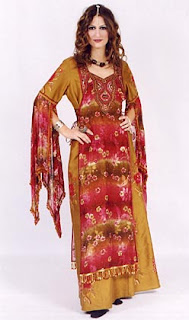
Fashions and fashion shows were not something foreign on Iraqi society. The first fashion centre in Iraq was in 1969, by artist Firyal Al Kelidaar, who came up with the idea at that time during her trip back from a fashion exhibition in Rome, Italy, when she noticed that one of the customs designed during the show was inspired by the Akkadian culture without any mention to that. Thus, the main purpose for establishing the fashion design center in Iraq was not for commercial reason, its purpose and pure goal was to re-live the achievements in that regards of ancient civilizations in Iraq, from Sumer, Akkad, through the Islamic heritage, into the Iraqi folklore. The first Iraqi fashion show was in 1970, in Rome, Italy. This followed by a tour in other European countries, East Asia and North Africa. In 2003 the Iraqi Fashion Centre continued its work gradually after months of hault due to war and looting and there are plans to present Iraq and its great civilization through fashion soon.

Below are a number of pictures of Iraqi models wearing different clothing made by Iraqi fashion makers